

How Does Valorant Rank Work
The VALORANT competitive mode is one of the about popular playlists in the game. Players enjoy testing their skills confronting similarly matched opponents and climbing into higher ranks.
Merely many players don't understand how the ranked manner works and how the game determines their skill level.
Hither's everything yous demand to know about VALORANT's ranked way.
Placement matches and requirements for VALORANT ranked play
Before unlocking the competitive mode, players must win ten unrated matches. Initially, players were only required to play 20 unrated games, just this was piece of cake for smurfs and trolls to complete. The new criteria to unlock the mode requires more commitment and dedication, which should aid eliminate smurfs and other problematic players.
When y'all've completed your initial 10 unrated wins, you so have to play five placement matches. This is designed to permit the game to effigy out which rank a player belongs in based on their operation in these matches.
Just even if you lose all of your placement matches, your performance will be taken into consideration. If you're consistently fragging and topping the leaderboards, your rank volition be college.
It's possible to consummate the placement matches with friends, but it tin require players to consummate the games alone if the organisation detects a large skill discrepancy.
Altogether, your subconscious matchmaking rating, determined from unrated matches, your personal performance, and your win ratio across your 5 placement matches will all go towards your initial rank.
Matchmaking rating
VALORANT, like many other competitive games, uses a matchmaking rating organization, normally abbreviated as MMR. Each player is assigned a number based on their in-game performance that adjusts over fourth dimension.
Players cannot see their MMR, but their games should be populated with players like in skill. This allows each game to be evenly matched even if some players are at lower or higher ranks.
According to the developers, players must consistently win at their current skill level to increase MMR. MMR does non always correlate with rank, simply players tin can track their progress with the Ranked Rating arrangement.
A player's rank tin surpass their MMR in some cases. If this happens the system will try and push them back down to their intended rank, which is why sometimes players will lose more Ranked Rating when they lose and gain less when they win.
If a histrion'southward MMR is college than their rank, they will gain more RR on wins than they lose for losses. If the MMR is even with your rank, yous will gain and lose closer amounts for wins and losses, which is chosen convergence.
Players are typically placed on the low-end of the convergence to test if they are actually better than their current opponents. If this is accurate players will gain more than RR for wins and converge with their MMR.
Performance-based RR
Riot Games introduced a Ranked Rating arrangement in Episode Two, Act One to assist players understand their ranked progress. Previously, up or down arrows were the merely indication of progress, but the new Ranked Rating shows players exactly where they stand up.
Winning and losing matches advantage players with RR points based on their functioning. The better a role player does individually, the more points they will receive after a lucifer.
Each rank has 100 RR points, and gaining more or less will crusade players to be promoted or demoted. Players who are demoted will not be placed below 80 RR points in the lower rank. Being promoted starts players at 10 RR of the next rank subsequently a win.
Performing well in lower ranks allows players to rank up faster if they consistently boss their opponents. But their MMR volition maintain their placements against similarly skilled players.
Tiers and divisions
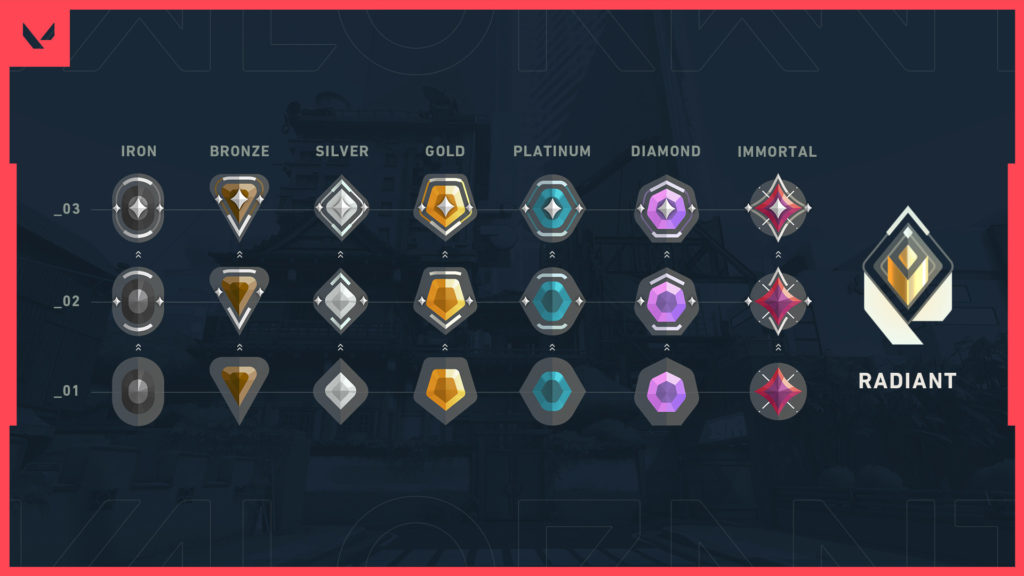
VALORANT has viii ranks (or divisions). There's Iron, Statuary, Silver, Aureate, Platinum, Diamond, Immortal, and the highest rank, Radiant.
The highest rank used to be called VALORANT, but Riot changed its name afterwards community backfire.
Each rank has iii tiers that you progress through. Fe one (for example) is the everyman tier in the Iron division, while Fe iii is the highest. When you're done with Iron iii, you'll promote to Bronze 1 (or potentially higher). Radiant, though, has just i tier.
You can skip tiers and even divisions if you build up plenty matchmaking rating. Personal performance and frags are also taken into consideration. If you go along a large win streak and consistently bag yourself MVPs, your chances of skipping ranks will exist higher.
"Winning games is the nigh important factor in gaining rank," co-ordinate to Riot. Just performing "exceptionally well" can help you rank up faster.
Ranked decay and new acts
VALORANT does not feature rank decay, but players will demand to complete a placement match if they are inactive for an extended period. Their rank will be adjusted based on the performance of this match.
Each new act resets ranks, and players must complete ane placement lucifer to earn their rank. Actor'due south RR and potentially rank tin change based on their performance in this friction match, simply the change is based solely on that game.
New players will nonetheless need to consummate their 5 placement matches to be assigned a rank. High-leveled players must meet other restrictions and requirements for each act, which can be found in the Patch two.04 patch notes.

How Does Valorant Rank Work,
Source: https://dotesports.com/valorant/news/how-ranked-works-in-valorant
Posted by: orourkealateve.blogspot.com
0 Response to "How Does Valorant Rank Work"
Post a Comment